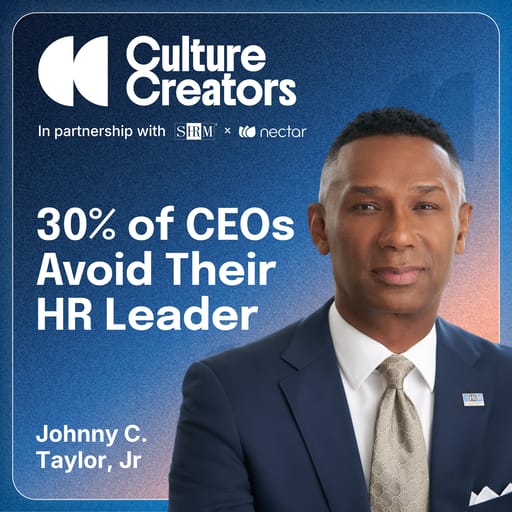
Transcript 0:00 The world of work is changing in ways that none of us could've ever imagined. Johnny C. Taylor Jr. is the president and CEO of SHRM, the world's largest HR association. 0:12 He's advised US presidents and shaped national workforce policy. CEOs tell him things they won't tell their own HR leaders, and today he's sharing their biggest frustrations with human resources. 0:24 I'm at an event with about 50 CEOs, and I said, "I want you to be honest. What do you think about HR?" 10% love, 60% tolerate, 30% of this room said, "I actually don't like the person at all." 0:40 Why don't you just replace them? Yeah, get them out. Right. And the answer was, "I don't think it'll get any better." Oh. [upbeat music] Let's go. Okay, let's go. All right. Johnny, it's so good to be with you. 0:54 It is so great to be here, and I mean that. You know, I just love your work. Thanks. I love what you stand for, so I'm really excited to be here. Thank you. 1:01 Well, we're talking about something that I know you and I are both passionate about- Yes... that I don't think we talk about enough, and that's this relationship. Ooh. The relationship... I'm just pretending. 1:11 I know I love Jim Link. Yes. But the relationship between the CEO and the chief HR officer, chief people officer, chief work officer- Yep... whatever this role is. Yes. 1:22 Talk to me about how you see that relationship in your world and organization at SHRM, and then with all the wonderful companies you get to interact with. 1:31 You are hitting the t- the, the sort of the nail on the head here, and I'm gonna tell you anecdotally something that happened. 1:38 So I'm at an event with about 50 CEOs of call it the Fortune 250, so these are the big, big company CEOs. And for those who are listening, this applies to all CEO relationships, but this is my situation. 1:53 So I'm sitting there, and I'm giving them permission. I'm the HR speaker, and I said, "I want you to be honest. What do you think about HR?" Ooh, I love it. "What do you think about your CHRO?" 2:04 And so I let them open up and talk, and I... And so let me tell you what I, where we landed. And this is rough math, but it's pretty darn accurate. 2:13 I asked the question, "How many of you love your w- your working relationship with your C- CHRO?" Then I asked a second question, "How many of you tolerate your CHRO?" Mm. "How many of you don't like your CHRO? 2:30 I mean, just literally would..." So the math goes this way: 10% love. Mm. 60% tolerate. 30% of this room said, "I actually don't like the person at all. 2:47 I don't even know why they're there. I avoid them." Yeek. I was shocked. 2:53 And again, this wasn't term scientific research validated, but I'm giving you real numbers in a group of people, and this was the sentiment, and I think it represents. Think about that. 3:04 10% of them are in love, and you have been in that situation, and I have been in that situation- Yeah... that I knew this was, like, the right chemistry- Yeah... and we made magic. Yes. 3:16 And I've also worked in situations where we kinda tolerated each other. By the way, HR people, this is not like the CEO's always right. It's just, you know, that's what... We just do our jobs, and we do what we do. 3:28 I've also had one instance in my career where I literally did not like being there, and I'm convinced they didn't like me being there. [laughs] Like it just is- Yes... what it is. But 30%. So I asked. 3:40 This is the part, just get to it. I said, "So of the 30% of you, like, what's going on there? Why don't you just replace them?" Yeah, get them out. Right. And the answer was, "I don't think it'll get any better." Oh. 3:53 It hurt me to my heart. It hurts me too. Because you're saying that this is just what you think about HR, that it's never gonna be great. 4:00 It's never gonna even be good to the point of me tolerating it, but this is a necessary evil. That math, 10, 60, 30, is why this conversation is so important. 4:12 We as HR professionals have to really look at the man or the woman in the mirror and say, "So where am I?" Ask that question, and then what am I gonna do about it? 4:23 So I remember sitting down with the CEO for whom I was working. For those who don't know, I've been a Fortune 500 CEO, a CHRO. I've been a CHRO of a division in a Fortune 500 company- Mm-hmm... Paramount. 4:35 Like, I've done all of these jobs. You've done it. And I've been at small companies. Yeah. LendingTree, which was small when I started- Yeah... and still is relatively small. I was at Blockbuster when it was small. 4:45 So, like, I got the gamut of all of this. You do. It's really interesting. So I asked him, I said, you know, "What's going on there, and what can we do about it?" 4:53 And I think we have to engage in some serious introspection 'cause I don't actually think some of those CHROs were bad CHROs in the 30%. I think they were misplaced. Right. 5:05 They were in an organization where no matter what they did, they would never be valued. I was in one of those before, and I literally got to the point where I said, "This is a Fortune 500 job, but guess what? 5:16 There are 499 others." Yes. And you have to come to grips with that, that this, just this dog won't hunt. Right. For any number of reasons, I am not gonna connect with this person. I'm not gonna be successful. 5:29 And why should you remain in a situation where you work so hard, you give your everything to it, and you're not valued? So then which side of the fence does it lie on, Johnny? 5:39 Is it we hear from CHROs, "My CEO doesn't value me"? The CEOs say, "I just don't wanna work with this person." 5:46 What is the impact to value that can be created by the organization when there's breakdown in this relationship? I mean, let me tell you, it's all wrong. 5:55 You wanna talk about a headwind in a business, if the CHRO and the CEO are not compatico, it w- it, it's just not gonna work. And the organ- And it's not just those two don't get along. 6:07 It is a drag on the organization.The CHRO who should be your go-to player in org... You've been in those shops where I have been the go-to person. 6:16 I had a CEO who just literally didn't do anything, even in their personal lives, without my opinion, right? Right. Right. And that's when you know it's going. Yeah. 6:25 When it doesn't, however, the organization feels it, profoundly so. I'm the person who's s- be s- s- you know, when I'm CHRO, the keeper of the culture. Yep. And I don't even have a good relationship with the CEO. 6:36 How can I keep this culture? I'm the person who's selling the organization to people. I'm inviting you to come work here, and I'm supposed... Then you're not gonna do it. 6:44 I'm the person that when the employee comes in and starts complaining about the culture here, if I actually agree with that person [laughs] Right? Yeah. Yeah. Just think about what I'm not doing from a value- Yeah... 6:55 point of view, per- perspective. So it's really, I... You asked that question, like, I think ultimately it's the CHRO because let's just face it, the CEO is whomever he or she is going to be. That's it. 7:09 And only the board can fire them, so it doesn't matter what I think about them. 7:14 So what I've gotta do, though, is not just when I run into someone who I'm not totally aligned with, I then have to use my persua- persuasion skills. Yeah. 7:22 I've gotta convince them of the value of what I do and my team- Mm-hmm... what we collectively do, and that then is incumbent upon us to make the business case. 7:30 Like, "Listen, we may not wanna spend the weekends hanging out together, but I'm really, really valuable to you, and what we do matters." That is incumbent upon us, and once you've done that math, though, once- Yeah... 7:42 you've explained it and the person still doesn't get it, then you leave. Have the courage to leave. But I- the immediate answer is not, "I'm out," or, "He or she doesn't get it. The CEO doesn't get it." 7:53 They are the customer. Yes. Remember that line about- Yes... the customer's always right? Yes. They're always right. They're always right. So you gotta figure out how to work with them. They don't have to actually... 8:04 A, a friend of mine had this horrible accident, horrible situation, but he had an accident, and she had an accident and ran into a tree. The funny thing is the tree wasn't going to give. 8:15 [laughs] The tree said, "I've been here 100 years. I'm not going anywhere." "I'm staying here." "I'm staying here." "My roots are deep." "Your car's in trouble." Yes. [laughs] "But you're in trouble." Yeah. 8:22 Airbag deflates, da, da, da. It... But that tree didn't move. 8:26 In many ways, that's what we as CHROs face is the CEO is who the CEO is, and either I think I can convince them and persuade them and show them the value, or I can't, and if it's the latter, it's time for me to leave. 8:38 It... That is the truth of it. That's- That's the advice you and I give- That's right... most people in the role. That's right. It's time for you to go. Time to go. So with your CEO hat on- Uh-huh... 8:47 how can I earn that with you? How can I be the weed next to the tree? That's right. Or the flower. Or the flower. [laughs] That's right. Use the flower. I talk about the three Cs. 8:57 Now, first, I'm a lawyer, so everything is in threes, uh, and I use alliteration a lot. So starts with, and I've gotten this from a lot of CEOs and from my perspective. One, you need to be competent, more than competent. 9:10 That's the first C as a CHRO. E- Can I ask a question just about that? Right. Is it EQ or IQ for you? It's both. Okay. You gotta be smart. Yep. 9:19 You need an IQ because the people, your business clients, your other cl- they're smart. They are. Right? So if you don't know your business, if you don't underst- you're gonna fail. So it's EQ and IQ. Mm-hmm. 9:28 You also need to understand the body of work. That is HR. That's your business. Right. Yes. We're supposed to be the people experts in the room. Mm-hmm. And if you don't actually understand this... 9:40 Now, that doesn't mean you... I loved you talking the other day, this morning, about people doing rotations. Yeah. But you've gotta know HR. Yeah. That's like coming to see a lawyer and that lawyer doesn't know the law. 9:51 Right. Now, there are hundreds of different types of specialties in the law, but I need some comfort that when I'm in a room, my general counsel is the smartest person about the law. Yes. 10:01 You must be the smartest person in the room around the business table when it comes to people. Mm-hmm. Now, everyone thinks they know people, but you have to prove that you're the smartest person, so competence in HR. 10:12 Mm-hmm. Secondly, you've got to be literally the confidant- Yes... to your CEO. So gotta be really competent, and then that person has to be your go-to, but they have to trust you. 10:26 They've gotta come to you and say, "This is how I'm actually feeling about that person on this team." Mm-hmm. They have to trust you. They... 10:32 I mean, I, as I said, my CEO used to tell me about what's going on in his marriage, more than I wanted to know. Oh, I've heard it all. All. Right? But it impacted him at work. Yeah, it did. 10:41 So I was the person who helped him. I was his, uh, Wendy from Billions, if anyone watches. That is the job, though. That's the job. It is. It is the job. Help get the most out of people, and help 10:55 m- manage that CEO, all that comes with him or her. I talked to a CEO last week. They're using AI for it. Yeah. Say, "Treat me like I'm Wendy- That's right... and give me that advice." That's right. Yeah. 11:05 Isn't that something? It's amazing. So, so, but that requires a level of trust. It does. I have to trust you implicitly. I can't think you're the HR police. Yeah. 11:14 And so if I come tell you how I really feel about something, that will be used against me at another time. 11:19 You see, as a former lawyer, what I know is that I, if, if my client, the CEO, comes and tells me something, it's locked. It can't go anywhere- Yeah... because of attorney-client privilege. That's right. 11:30 There is no such thing officially for HR people. So as a result, I, as a CEO, if I don't trust you, I'm not gonna tell you everything. I'm not gonna tell you what I'm going through. 11:40 I'm not gonna tell you what I'm thinking because it will be used or can be used against me later. So you have got to build... The successful CHRO, to answer your question, must be the confidant- Mm-hmm... 11:51 to the CEO about everything. Yep. And the third area is courage. Yes. Uh, it's it. You gotta be competent. You must be the smartest person in the room when it comes to people. 12:02 You must be the confidant to your CEO, and you've gotta have courage. And you've done it, times when you walk in, and no matter what, you're like, "Listen."That's not the right place to go. It just isn't. 12:13 And the willingness and the courage. But here's the deal: you cannot be courageous in your job if you're not competent- Yeah... and if you're not the confidant. Oh. Right? It's true. 12:21 The courage can't come- You have to have all of them. Right. You need all three. 12:25 That, to me, is the secret sauce, and as a sitting CEO, and I've now been one for 16 years, in different settings, for-profit and non-profit- Yes... 12:36 when I have a CHRO who checks all three of those boxes, we are cooking with grease, as we say in the South, right? [laughs] It's so good. Life is good. Yes. But two of three, one of three, doesn't work. 12:47 And so back to that, remember I talked about the 10, 60, 30? Yes. When a person has one of those three, they're in the 30 box. Yes. When they have two of the three, they're in the middle 60%. 12:59 When they have three of the three, they're part of that 10%. And boy, I am at my best- Yes... as a CEO- Yes... when I have that CHRO. It's magic. It's pure magic. Yes. 13:10 Can you share an example when you've had that magic and you were in conflict, or you had a significant situation that tested both of you? Hmm. Yes. Yes. So I have to protect the innocent. Protect. Remember the lock box. 13:25 We are. I won't use names. We are in a lock box. Right. And, and so, um, I was the CEO, and I had an imp- the CHRO comes into me. I fully trusted this person. I won't even give him gender. No. 13:37 [laughs] Trying to protect everyone. Again, that's that confidant nature. It is. 13:42 So the person comes in, my CHRO comes to me and says, "One of your senior executives, very productive, has been accused of inappropriate behavior in the workplace." 13:55 And, um, the CHRO's recommendation was to terminate him. Mm. And I just- Had they done the investigation? Uh, yes. And what, what happened, this is interesting, we kinda disagreed about the severity. 14:09 You know, we've been there, right? We've been there. Where, you know, there, there's the thing, A, you did this, which is no question, and then there's this middle gray area where it was wrong. 14:21 What he engaged in- Yeah... was absolutely inappropriate. And I'll tell you, I can just be very transparent about this much, dating a subordinate, tough one. Tough one. But it happens all the time. 14:32 It happens all the time. And so people shouldn't live... And that was the thing. I was on the CEO c- CEO side saying, "Are you serious?" Yeah. "I'm gonna lose two really good people over this." Yeah. 14:42 And that's not good math. Like [laughs] it's just not. No. You're telling me both people are really talented, and, and no one feels forced in it. 14:51 And I know some of you, I know if anyone's listening, the traditional s- HR people are gonna be like, "Johnny, that's an easy one. You don't date, uh, Coldplay, da-da." Like, they're gonna go on and on and on, right? 15:02 But stop. 15:03 As the CEO, you're telling me that I'm going to lose a star for a consensual, a fully consensual situation, that frankly, we didn't even know it was going on, and we wouldn't know if some nosy employee hadn't told us. 15:16 Right. So how do we fix this versus the easy answer, which is fire both of them, or at a minimum, fire my senior person. We had a tussle over that, me and my CHRO. 15:32 And because I trusted the CHRO, we could talk honestly. Yeah. And it was like, "Are you serious? You think this will hurt the business?" I said, "Have you talked to the employee? 15:43 Does any part of this, does she feel like she was forced to do this? Is she- Mm-hmm... frankly in love with him? Like, let's just talk about this." Talk about all the things. All of the factors. 15:53 And she said, "Uh, but our policy says..." I said, "Well, how about changing the policy?" If we know people are dating at work anyway. Right. And guess what? It works sometimes. B- Barack and Michelle. Yes. 16:07 They're examples of, the Obamas. They are. They worked at the same law firm. She was senior to him. Yeah. Blah, blah, blah. They dated, blah, blah, blah. It's a great example. Yeah. And so when it works, it works. Yes. 16:16 So if everybody's fine, what's it me? I'm gonna fired w- two talented people because of this? No, I'm not doing that. No. So we had a tension. 16:24 We solved it, and we resolved in, like, let's ensure that there's no legal risk to the person. We got everybody to come in and sign and say, "Yeah, I liked dating this person," and blah, blah, blah, right? 16:33 [laughs] "I don't feel harassed." And we don't feel harassed, none of that. "I'm not being held hostage." Everything's good. 16:36 I've not, uh, d- given this person higher increases or bonuses over other people, and we're gonna monitor that going forward- Mm-hmm... by the way. But I'm gonna continue to let them work together. That's amazing. 16:49 That's what I want as a CEO. Yeah. And my CHRO had to evolve with me to understand why that was the right decision under those circumstances. Yeah. Neither of them was married. 17:00 You know, there were things, any bit of factors could have, any single factor could have changed the outcome of the decision. Yes. But for us, the easy answer for that CHRO was, "Fire him." Well, it often is the easiest. 17:13 Yes. It takes the least amount of thought. It follows the policy. It stays within guide rails. And no courage. No courage. That's- That is the biggest thing. That's right. And what is right for the business. 17:23 That's right. That's right. No, totally, that's, that's the big question mark. Yes. Don't use, I've learned, policies to, to, to, as sort of a tool to make your job easy. The policies, there are some rules. 17:36 There's some guidelines. There's some places you cannot get outside of this box. If you're harassing someone, if there's some force, you know? Right. Anything like that, there's no room for... That's not great. 17:47 But here are two people who've decided to, and as I said, there are q- a number of examples, heck, s- historically, a number of CEOs' wives were once their EAs, right? It's true. It's true. I mean, it's like- Yes... 17:58 so it was happening anyway. And then, then it's especially acute, if you will, with the younger workers. Yes.Who do you think they're gonna know? Well, and they don't have anywhere else to meet people. Right. Yeah. 18:10 Proximity matters. We know there's a proximity- Yes... bias, so I'm spending all day with these people. Now, we could argue that's good or bad, and some people have, like, do I think it's a good idea? Probably not. 18:21 But if you two can figure it out- Yeah... and HR, your role is not to break up the relationship. No. Your role is to make sure the company is protected, that the company's aware of it. 18:30 We have a rule now at SHRM, it's part of our policy. Date who you wanna date, everyone, but what you must do is the two of you have to go to HR. Be transparent. 18:39 Be transparent, sign off that says, "I'm not being harassed, I'm not expecting anything, special favors," da, da, da, da, da. Right. 18:46 And if you break up and you break up at my office and all hell breaks loose, then both of you are gone then. Yes. [laughs] Right? Yeah. Just say it. That's the policy- Yes... 18:54 that's realistic versus people shouldn't date at work. How dumb is that, in my opinion. Yes. This example's so useful. So talk about confidence with this. Yes. 19:05 In that example, your CHRO wasn't going out to the rest of the executive team- Right... and saying, "Well, Johnny was really on the fence about this." Right. You know, "He really debated this. I'm not sure." Right. 19:14 You can't take it out of the circle of trust. You can't. Ever. Trust, and that's why it's a circle. It is. There's no off-ramps. [laughs] Right? [laughs] There's no exit, yeah. It's better stay in here. Yeah. 19:24 When you have that, you, it's magic. When you have that trust, and it's not one-way trust. It's two-way. It's not the CE- That's right. It's two ways, 'cause the flip side is we're human beings, too, as CHROs. We are. 19:36 And there are times when you're gonna come to your CEO and say, "Listen, I, I made a bad judgment call." Yeah. "I'm not doing this. I'm doing..." 19:42 Like, there are ways, this has to be pastor penitent, um, uh, clergy pen- or whatever it goes, right? Yes. Attorney-client, whatever, it has to be a box. It does. And here's what's really interesting about it. 19:53 It's gotta be a box that lasts past the moment. So I worked- Mm-hmm... and I'm gonna be really careful here. I worked for someone who as their CHRO, who held a very personal secret, and, um, I saw it. I knew it. 20:11 Um, none of my business, right? Mm. I, I'm not stupid, right? Right. But because of our relationship, I kept it absolutely till the... I mean, I never released it. Subsequently, this person told the world. Mm. 20:27 And I got calls. Now, this is decade or so later, people, "You must have known." I said, "What?" [laughs] That was my answer. Oh, my God. What? What? Because even after I left, because other CEOs are watching you to see. 20:43 They are. Right. Can you j- You left your last company. Do you go in the market and tell everyone all the secrets you knew from that CEO? That's horrible HR. Horrible. 20:52 And when we do that, we lose trust, not only your trust with that CEO, which you may say doesn't matter 'cause you don't work for that person anymore. But it harms the HR, the reputation of the profession- Yes... 21:04 when people think that we would take stuff later and put it out there. 21:07 How many cases have you investigated over your career at former companies that you could now, you don't work there anymore, you could go out in the street and say, "Yeah, well, I investigated this case, and this was going on, and she stole this," and you can't do that. 21:21 Can't do that. HR loses its credibility when it can't maintain confidentiality. Well, even a step further, I lose my credibility. That's right. I lose my integrity. That's right. And we don't... 21:32 That's where it, it confuses me, Johnny, where we don't need a policy. What about just human integrity- How about that part... of being a stand-up individual that you can count on no matter what? 21:43 Like, I have your back no matter what. No matter what. Employed, unemployed, doesn't matter. I might ask you the hard questions. That's right. I may not agree all of the time. I'm going to tell you directly. 21:53 That's right. That's right. Yeah. And then we're gonna have a decision. Had this phrase at, uh, SHRM. It's our final guiding principle. We have six of them. We had five. 22:01 We added this one, and it's three words, and it's in this order. Our culture says, "Challenge, decide, commit." Mm-hmm. That's it. That's it. It's challenge, period. Decide, period. Commit, period. 22:13 What that means is you are encouraged in our shop to challenge ideas- Yeah... challenge people because it makes us better. There may be a perspective I hadn't thought about, and that's up to and including the CEO. Yes. 22:25 Everyone can challenge our ideas. The organization will take all of the input and then make a decision for the organization- Mm-hmm... which of course factors in people, but at the end of the day, it's a decision. 22:39 You then as an employee have to decide to commit or not. Yeah. That's an individualized decision 'cause you've been given the opportunity in a safe, psychologically safe environment to raise the issue. 22:51 We then make a decision- Mm-hmm... which you may or may not agree with, but then you have to decide to commit. And once you've committed, you are in. I don't wanna hear it again. Yeah. Like, don't look back. 23:02 It drives me insane, you know, when people look back, "Well..." No, no, that decision was litigated. It's not gonna be really relitigated, and now you are committed to it. 23:11 If you can't commit to it, you should go somewhere else. Yeah. So I wanna add let go. Yeah, let go. Commit and let go. I love that. Let go. Like, move forward. [laughs] Frozen. [laughs] Totally. "Let it go. Let it go." 23:20 [laughs] My daughter played that. Oh, my God. Oh, mine too. She was a little girl at the time. It drove me insane. And wore the dress. Right. Yes. [laughs] Totally, and the shoe, the whole deal. The full thing. Yeah. 23:28 [laughs] So what advice would you have then for CHROs? Just, we've got the three Cs, which are gold. Yeah. Thank you. But if they're really struggling creating that connection with their CEO, what is your advice? 23:42 I, I can give you, it's, it's, 'cause it's very personal, and I remember doing it. I had a disconnect with one of my CEOs, uh, so once, and it ended up... This is a positive story. We ended up in a perfect place. 23:52 So the easy answer is if it's not working, leave. I called him up, and I said, "Hey, uh, let's go have lunch." And then I changed it. I said, "Let's have dinner," because I find that lunch y- y- it's not open-ended. 24:07 There's a time. Yeah. And I gotta go back to the rest of my meetings, and I wanted to sit down without the pressure of time.And we went to a place, uh, and I'm trying to remember the name of it, but it doesn't matter. 24:17 But this old rickety restaurant kind of deal, and we sat. We talked for about two and a half hours. Yeah. And I started with not, "How can I help you? How can I..." No. "Tell me about your life." Yeah. "How's your wife? 24:30 How are the kids?" You know, and I asked the question, "What keeps you up at night?" Mm. And so we talked about it, and I didn't limit it to what's at work that keeps you, but literally- Just in general... 24:40 'cause I'm getting to know the human being on the other side. And call it an hour and a half in, uh, 'cause we were actually just enjoying each other. Yes. 24:48 And I had never spent that much time getting to know this person- So important... and what is, what are their drivers, what are the- Yeah... 24:54 demotivators, et cetera, which was my fault because during an interview you don't get that much time. No. 24:58 You're interviewing for the job, you meet the person, you get an hour, they look at your resume, and they decide, right? Yep. So we never took that time. Mm. 25:06 At the end of it, I said, "Now, listen, um, I want to work here." And I looked him straight, straight in the eyes. I said, "I want to work here, and let me tell you what my job is. 25:15 My job is to make you and this company successful." Mm-hmm. "It's not to make me successful, 'cause that's a byproduct of making you and this company successful. What do I need to do?" I said, "This is your safe space." 25:29 Yeah. "What bothers you about me?" And he opened it. I had to give him permission- Yeah... 25:39 to tell me, and, you know, there were moments, parts of it that didn't feel exactly great, but we talked for another hour and a half. This turned into a three-hour dinner. So awesome. 25:50 But I walked away understanding the truth for the first time, 'cause I- His truth. His truth, and I, 'cause I couldn't figure out what was going on. Yeah. I knew I was... 26:03 You know, it was just a m- And once I got it, I had to make a decision. Back to your point, this is my decision- Mm-hmm... commitment moment. Mm-hmm. Now that I know honestly what he wants- Mm... 26:15 from a CHRO, asked myself, "Do I wanna do it?" Do I want that job? Because maybe I don't. Yes. Right? And you and I have been there, right? We've been there. And, uh, I made the decision to stay. 26:25 He has literally, and unfortunately, he just died. Oh, I'm sorry. Young guy in a horrible accident. Oh, I'm sorry. He's the CEO of LendingTree. I can tell you, Doug Lebda was his name. Yeah. 26:36 He just died a couple, three months ago on a, those motor vehicle, off-road motor vehicle. It flipped on him. Oh, good grief. So 55, 56-year-old- So young... young man. 26:46 And he, and of course, the younger you are, the younger that... I mean, the older you are, the younger that looks, but yeah. And Doug and I became this tight. 26:51 He called me up randomly about a year, call it a year and a half ago, and he said, "I was talking to my current CHRO and saying how much I missed you." Mm. 27:03 Now, this was a situation that I was convinced was not gonna work. Not working. You know, I was like, "This is not..." But I gave him permission to tell me, "You're the customer. What am I not doing right- Yeah... 27:15 for you?" To your point, I love when you say your truth. Not the truth. Mm-hmm. Mm-hmm. Your truth. Mm-hmm. And once you do that, anyone who's look- You have to give CEOs the permission- Yeah... to be honest with you, 27:28 right? Yes, but there's something that happens that I want you to share. How is your mindset to handle the uncomfortable things he was sharing with you and not be defensive? Hard as hell. 27:39 [laughs] Like, I don't know what... It's hard. So hard. No one wants, especially at our level, you've achieved it, right? You're the CHR or the CPL, the... And titles don't really matter, but what i- you've done it. 27:52 Top dog. Right, and now someone is suggesting to you that you're not good enough, what you do doesn't really matter. Uh, it's not a business function. Like, there's a lot of things that... And so I l- I'm not a drinker. 28:07 I told you I've never had a drink in my life, but I probably should've gotten one before I had that conversation. [laughs] Because he was brutally honest. Yeah. And it wasn't like the stuff that you'd think. It was... 28:19 And I remember, can I tell you just the two- I would love to hear it... three things that came up? Number one is he said, "You're too judgmental." Was that a new piece of feedback, or was that a theme- It was-... 28:28 you could anchor? I could anchor it, but it was new because it wasn't s- it was direct. Mm. It, and that's, it has informed who I am as CEO, even to that earlier story before. Like, I'm a lawyer by training. 28:40 I came into HR by the law, so therefore, I made judgment calls for... You're gonna say. Well, I feel like it comes from the spirit of being curious. I get this feedback, too. Yes. 28:51 And so I ask questions like I'm interrogating somebody. That's, exactly. Okay. But mine went a little s- further. I used to be a pretty black-and-white guy- Mm... because of my law- legal training. Yeah. 29:01 That's right, and this is wrong. Wrong. And here are the rules to support it, and I had no tolerance for risk. Oh, okay. That's what it tied into. So that ju- This is a big one. Right. It's a big one. 29:11 F- especially for f- founders. For founders, for sure, 'cause they have a uber tolerance for risk. Yes. Like, an out of... 29:17 I mean, look, see what, say what you want about Elon Musk, but the reason he's successful is he has a, a unbelievable tolerance for risk. Yeah. 29:25 You can't support such a person or be a part of their team if you don't have it- Yeah... or at least respect that they have it- Right... and help them wi- in it. So that was one of the... 29:35 That was the first thing that stuck me. He said, "You're too judgmental." Mm-hmm. "And in the process of doing so, you wanna play it safe, and I'm an entrepreneur. I'm trying to grow LendingTree. 29:44 It's a new concept no one thought about, and this doesn't work." That was number one. Okay. Number two, "You actually don't know our business." Uh-huh. "You know the HR business. You don't understand how we make money. 29:59 You know all of the right language, EBITDA, EVA at the time. You know all of that good stuff. You've taken a course at Harvard for finance for non- Mm... finance professionals, like, boo, boo, boo, boo." 30:08 He said, "But you have no idea how we make money, what levers I have to pull and push to make money here."And he said, "For example, you have no idea how much we actually spend on our call center." Mm. 30:22 "You got 500 employees over there. Have you and your team ever thought to go ask what we could do this if we outsourced it, co-sourced it? Have you ever thought about that?" Mm. "You'll do it if I tell you to do it 30:34 as a project, but I want you coming to me- Thinking about it. Yes... as the CHRO saying, 'I know we spend X millions of dollars on this, and maybe we can spend X minus- Yes... and, and still get the same quality.'" Yeah. 30:46 And it was really... And I said, "Whoa. You're right. I never thought I could come to you and tell you your annual merit increase budget according to Hewitt and Associates or whatever is supposed to be 3.5%. 30:59 So we spent a million this year, next year we're gonna m- spend a million plus 3.5, and, and I would argue with you that if you don't do 3.5%, we're not gonna be competitive to market." 31:08 He said, "You know your craft, but you don't know my business." Mm. That was so sobering. I had to step back, and as a CHRO, act like a true business person. Yes. Right? Have you- Yeah... had that? 31:21 But that's hard, 'cause we're not wired that way, and we manage a significant... I mean, number one or number two biggest expense line in a business- Ours... are people. Yes. 31:31 Yes But we don't think about, we manage within that box- Yes... as opposed to. So that was the second. And then the third one, which I, I'm, um, I'm still kind of, I think he's right. He said, uh... 31:46 A- and I'm trying to remember exactly what it was and the language of it so that I get it right, but, 'cause I don't remember the specific language. But the real takeaway was, 31:55 "You're competing with your colleagues, and I can see it." Oh. I think s- too often we as CHROs- We wanna look good... 32:06 we wanna prove that I'm as import- as important as the chief marketing officer, I'm just as important as the CFO. So you end up competing, and it's obvious. Yes. 32:16 So you now can't turn around and ask that CMO to partner 'cause they understand you're a competitor. Yeah. You're not a supporter, you're not an enabler, you're a competitor. Competitor. 32:29 And, and I asked him, he said, "It's very clear to me one day you wanna be a CEO." Mm. I said, "Yeah." He said, "It's very clear to everyone else sitting around the table." Yeah, too. 32:39 [laughs] And, and it was such a moment. I was like, "Oh, that's a dirty little secret. I thought I was hiding it." I thought I was the only one that knew that. [laughs] And I wasn't. 32:49 And so they won't use you as a resource because they see you as a competitor. Yeah. He said, "Do what you do really well, which is to facilitate these people looking better. You'll become a CEO that way." 33:00 And so this morning- Oh... when y- the CEO, former CEO and founder of Plur- Pluralsight- Yeah... said that- Yeah... 33:07 one of your guys, you might want to tell the story, but that was his point, was that guy's gonna be a CEO. Yeah. He doesn't have to compete with everyone else around the table. Right. 33:17 His natural genius is gonna come out. It will. Yes. Yes. That's incredible. So those are the three things that I... And I, that competitive... 33:26 'Cause I was the general counsel who became a CHRO on my way very clearly to the seat I sit in. Mm-hmm. Everyone else saw that. Mm-hmm. But at that time, that's rare. 33:37 There aren't many CHRO successions into the CEO chair. It's not. That's right. It's not. And, uh, we've gotta find a, you gotta b- find a better way to it. Mm-hmm. You don't wanna do... 33:47 I was so damn obvious that, again, I, I think it was clear. But it's what we should, because I think some... And Mike Milken has famously said he thinks the CEO of the future will come from the CHRO ranks. Mm-hmm. 34:00 He fundamentally believes that. 'Cause we're in a knowledge-based economy, and if you truly do what Doug told me to do, which is understand this business, yes, understand your craft- Yes... 34:10 but understand this business, you are, you control, control the biggest lever- Yeah... in most organizations from a budget standpoint. You could be that person- Yes... without competing to... 34:23 Because I would try to outshow... 34:25 There's, I now, as I reflected on it, and I don't mean now, I reflected on it then, I'm sitting in a meeting and the CFO would start going through their report, and I was, I would ask probing questions to prove that I had read- You were smart... 34:37 I was as smart as the CFO. Mm-hmm. And the chief marketing officer would do a presentation, and I would give some thoughts about what's your CAC. Mm-hmm. Like, I was using the language- Mm... of business to prove it. 34:46 You were. And what I was doing was alienating the rest of my team, because that confidant nature actually needs to apply to the entirety- It does... of the executive team, right? It does. 34:58 One CEO I loved that I worked with said, "You're my business partner for me and the team." For me and the team. And that's exactly how it is. That's right. Yes. It really, really is. 35:06 So I do think that, and I hope that the people who are listening, there's a real possibility that CHROs will be the CEOs of the future. I'm proof of it. And I hope I've shared that I had to bump my way into it. Yeah. 35:21 I, I did, and, and I'm lucky, because these could've been derailers. Mm-hmm. But it all ca- if I can say anything to you, I sat down with a CEO who I didn't exactly get along with. Yeah. 35:35 And I gave him permission to tell me why. 'Cause I knew that I got along with my past CEO. Mm-hmm. I mean, I was promoted into the CHRO job at a very young age at Blockbuster, so they loved it. 35:46 There was something about him that I wasn't connecting with, and my biggest learnings came from that conversation and that relationship. 35:54 Well, just to even boil it down further, you were willing to look at yourself to say, "It's not his problem, it's my problem." That's right. "What am I going to do to grow and change?" 36:03 Like your opening piece of it's on us as CHROs- That's right. That's right... to figure out how we're going to grow and evolve to serve this customer CEO. Period. 36:12 And anything other than that, it's, it's a customer service. It's, I, I read a lot of books on servant leadership. Yes. And a lot of people don't like that word, but I love it- I do too... 36:22 because it really speak, that phrase- Mm-hmm... 'cause it's not one word, but people don't like the word servant. Yeah. And I think that to do what we do, you have to have a heart- Yeah... 36:32 that says, "I actually want to see people be their best."Right? Yes. I want to see people succeed. I wanna optimize talent, and in doing so I'm going to be the equivalent of a coach- Mm-hmm... 36:44 in an NFL team or NBA team or whatever sport- Mm-hmm... you like. Coaches make a lot of money- They do... because they know how to find talent. Mm-hmm. 36:52 They know how to train and motivate and develop that talent so that we win. Mm-hmm. You don't have to throw a ball at all to be a very successful, well-paid coach CEO, but it requires a servant mindset. It does. 37:06 Growth mindset- Yes... but this idea that I'm here to help you be the best you can be- Yeah... and in doing so I'll get mine. [upbeat jingle] Hi, I'm Johnny C. Taylor Jr., President and CEO of SHRM. 37:17 SHRM has been a Nectar customer for a few years now, and we've seen firsthand the positive impact Nectar's platform can have on a company's culture. 37:26 Now, we're joining forces with Nectar to help more organizations build strong cultures where people feel valued and connected at work. 37:34 In today's competitive landscape, a strong organizational culture is more important than ever. 37:40 Meaningful recognition done consistently isn't just about boosting morale, but plays a key role in retaining top talent and improving overall performance. 37:49 I'm proud to be a part of this journey and look forward to seeing the impact Nectar will have on your organization. 37:55 Together, we can build workplaces where people feel truly appreciated and motivated to do their very best work every single day. Can you share a little bit about what that does for you as a CEO when it's so lonely? Ugh. 38:09 How many people care about you, ask how you are, "Can I do something for you," servant or not? How many times does that happen for you in the last 16 years? Rarely, and it usually comes from my CHRO. Okay. 38:24 That is s- Yeah... think about that. That's it. That's the person who, as crazy as it sounds, when Doug took a re- Doug was the gentleman who's now deceased, when he flew in on a red-eye- Mm... 38:34 I'm his CEO, I mean his CHRO, I called his assistant and said, "Uh, block out some time for him to have a massage." Yeah. Something as simple as taking care of him, because no one else does. Yeah. 38:48 His spouse, you know, is- No... th- got that. His kids want... Everyone's pulling from him- Yeah... even at home. Yes. So if I just facilitate and manage that thing to take care of him, that's the servant. 39:01 And I never took offense to it. I never thought I was too significant, too important for that. 39:07 I began to realize, and he would then tell me, literally he went through a divorce and he told me in advance, "This is what I'm going through." I knew it all. All. Right? Because it's a lonely job. Yeah. 39:18 My mother, I can talk to about anything, but she doesn't actually understand my world. Anything. She didn't... You know, she's- Yeah... she doesn't know this world, so I can't get anything to her. 39:28 And other CEOs, that's why you see a lot of increasingly convenings of communities of CEOs. Yes. Because it's so lonely- So lonely... that you can't talk to anyone else. No. 39:38 But you can only do this three or four times a year, once or twice a year, so having that CHRO to go down the hall, drop in their office and say, "Huh." Ah. That's the role that we play, because it is lonely. Yeah. 39:50 It's hard. And if you care, like I do, this ch- I signed a five-year contract with SHRM, whatever. So I don't... M- my life is not about my security. 40:01 I'm up at night saying, "How do I ensure that these employees have a job five years from now?" It's not just their employees. I stay up worrying about their families- Families... 40:09 and whoever else is on their benefits bill. Bingo. Yeah. Lives, as we [laughs] you know? Yes. How many lives do you ensure? And that is pressure. It's pressure. People don't understand that. 40:19 All they focus on is what we make and- What's in it for me... and our title and our corner office and everything, and you don't realize when you go home I'm still think- I li- live, breathe, s- uh, s- sleep SHRM. Mm-hmm. 40:32 And SHRM the brand and SHRM the employer. Mm. I live it. That's all. You look at my- You are one and the same. 40:37 You look at my closet and I'm like- [laughs] The other day I was like, "There's nothing in here but SHRM decor." [laughs] In fact, I was talking to our swag people. 50 shades of navy. Right. 40:46 They're o- [laughs] That's it. [laughs] They're ordering... I have SHRM socks. Yes. I literally... I don't have SHRM undies, but I have SHRM [laughs] SHRM socks. But they're making me now a blazer that has- Mm... 40:59 you know, SHRM- Yes... right? Like, you literally, because- Become... you care, you live this. Yeah. 41:03 It's hard to a- separate, inextricably intertwined, and therefore, uh, every employee should know that, should know that I'm doing this for you. Yeah. For you. So it's a tough job. You know it, but guess what? 41:15 This is something I do wanna say. The CHRO job is ju- it's the same job. I felt all of the pre- Yeah... that's why I thought it was good preparation for me. Yeah. It's a lonely job, a CHRO. Yes, it is. 41:27 It's a complicated job. You are worried. You said it. I'm just not worried about the employees, I'm worried about their families, I'm, I'm worried about the commu- Yeah... like, I'm worried. 41:35 And I know that I have to make, I serve two, two, two masters. Yes. The employee and the management or the business. And the board. And the board. So this is tough. Like, my stakeholder- Yeah... 41:46 group is not simple, and sometimes they are in conflict about, you know, what's important. And the customer. And the customer. 41:52 So all of th- so the CHRO job I daresay, and I say this and it's not just because I'm the CEO of SHRM, it's the hardest job on the management team, and I can say it because I've done it. Yeah. I've done both. 42:05 Uh, and it's in some ways even harder than the CEO, because guess what? You also have to keep the CEO happy. Yes. 42:11 You got a ton of customers and, and audience members, for those who are, believe in audience centricity in marketing. I got a lot of audiences to make happy. Yes. And it's not hard. It's not easy, right? 42:22 And it's really difficult, in fact. It is. It is. And that's when this relationship is magic, like we started with. Yes. If we're coming back full circle- That's right... 42:30 it's the place where I also can sit down and be safe. Yes. Like, almost, like, take the mask off and say, "I just have to vent with you about 10 minutes. This isn't a thing- That's right... 42:38 but I just need to get it out." Got it. "And then I'll put the mask back on and I'm back out in the, in the uniform." And I love when my CHRO does that to me. Right? 42:44 'Cause we are actually building a bond.Just by you doing that. Exactly, because you're extending the trust back. That's right. Actually, you can't be the one. 42:51 I don't like relationships where they're always asking me the questions. The whole time. It has to be mutual. That's right. Yes. Yes. When I was... 42:57 I went through a pretty, uh, no divorce is pretty, and mine wasn't ugly comparatively, but it w- it was, divorce hurts, right? Yeah. 43:04 And I remembered being able to sit down and share that with my CEO, like, just to say, "This hurts." Right. This was the same CEO that when I got married, I was another CEO at Paramount, 43:15 I showed her the ring that I chose. Mm. And I was like, "What do you think? Is this gonna..." So you can share your pod, that things- Yes... are going great, but you also... 43:22 And when I told her I'm going through this, it was a, it was a f- I had a female CEO at the time. I actually had female CEOs a number of times in my career. 43:29 But it was interesting that I could kinda say, "Jane," and by sharing with her my vulnerabilities- Mm-hmm... she then began to share with me her vulnerabilities. Yes. Yes. And again, that bond was so, so close. 43:43 I've had some amazing relationships. I've had one or two bad ones, but, uh, haven't we all? If you get old enough and you do this work, you're gonna have 'em, right? 43:50 You're gonna have 'em, and it makes the good ones that much sweeter. Gosh. Well, you now know what you want. Yes. I think about you. If you ever were to do a CHRO job again, you know exactly what it feels like. Yes. 44:01 And you know what questions to ask in that hour interview. Yes. As opposed to me getting there, uplifting my family, moving there, and then spending months saying, "What in the hell did I just do?" I know. And having... 44:13 Right? I've had some pretty bad rebound relationships, Johnny. Really? Yes. Tell me. I- Do tell. 44:17 Well, I mean, I just, I think that what sometimes people think they want in the job and all the magic that we've described, and then getting that is different, especially if they've never experienced it before. 44:30 Fair enough. I want you to have courage, and then I come with courage, it's like, oh, I don't wanna hear that. Oh, that much courage. [laughs] Exactly. Right? And so the question I'll ask is- [clears throat]... 44:38 what is it like for you to have me as your CHRO? Ooh, great question. It's very vulnerable. Great. It's kind of tantamount to me, right? It's very similar. Very similar to yours. 44:49 And then you have to be able to hear it in a way that you can actually absorb it. And w- in one situation, we had spent hours together. Now, the difference is we did not meet in person. Mm. 44:59 So even though we'd probably spent 10 to 15 hours together in the interview process, we didn't meet in person, and I think that would've been useful. Mm-hmm. 45:06 And I think having the dinner even before you go into it- Yes... you've got to do, especially if they're a first-time founder with a first-time C-suite. Yes. It's- They're learning... they're learning. 45:19 And so it really depends on phase and stage- Right... on how to get it right. You also, and I- I would say to CHROs, sometimes when you're in the market, you're in the market because you want a new job. Yeah. 45:30 I mean, that's why you're doing it. And as much as people say, "No, no, I don't, you know, I'm not looking," well, you wouldn't waste the time to do it. You're curious. You think you might take it, or why not? 45:38 Who enjoys this? Like, no one enjoys interviewing. I don't. But, um, you've gotta listen really carefully to who people tell you they are. Yes. One of my favorite- Yes... poets is Maya Angelou. Yes. 45:49 And she says, well, she's now deceased, but she said, um, "When someone shows you who they are the first time, believe them." Mm-hmm. Mm-hmm. 45:57 And as I reflect on the not so good relationships that I've had with CEOs as a CHRO, they told me. They told you. They told me. It's like a bad personal relationship. Yeah. 46:11 Like, if you actually reflect back on when we were dating, that person kinda told me. Yeah. I was just caught up in the moment. I wanted it. To- I'm caught up in the brand. Right. Many things. The brand- The title... 46:23 of the company or the b- the title, the money. The office. The office, all of that. Yeah. And you decide to ignore what you actually... And so you replay it 46:33 in your sort of life role, and you're like, "You know, during the interview, they did say this." Yeah. "I just was unwilling, and I didn't..." So spend enough time during the interview and really be listening. Mm. 46:44 Extreme listening. Like, what are they saying? And probing. Mm-hmm. Because when I'm on an interview, you should be interviewing me. Mm-hmm. 46:50 The last interview that I did for my CHRO job, I was like, "You should interview me as much as I'm interviewing you." Mm. 46:56 "'Cause we're gonna be tight, and if you don't like me or you don't see my worldview, this ain't gonna be good for you, 'cause I'm not going anywhere." No. [laughs] Exactly. Right? I'm here. [laughs] I'm here. 47:04 Back to where I started. The CEO's like the tree. Yes. And unless they do something really bad or don't deliver business results, they're gonna be around. They're gonna be around. The question is, will you be around? 47:13 [laughs] So you've gotta figure out, can I, do I wanna work with this person? And that's, that's, we interview too much and, and we court too much- Mm-hmm... 47:22 as opposed to really asking yourself, "Am I prepared to spend most of my hours, waking hours, with this person?" Right. Right. It's an amazing question. Or, do I wanna be on a 12-hour plane flight with this person? 47:33 That's right. I love that one, too. Yeah. That's right. Yeah. And, and do you figure it out the first night, first date on the... 47:40 No, maybe not, but, uh, but you gotta ask yourself that, and ask real tough questions during the interview. 'Cause I, like, I'm big now, even when I took this role, Donna Morris- Mm-hmm... 47:50 uh, as sh- as the, uh, the CEO, CHRO of Walmart, she was actually the head of the search committee for SHRM CEO- Mm... when I was hired. And I'll never forget, like, asking her some real... She was at Adobe at the time. 48:05 Mm-hmm. And I had some tough questions- Yeah... 'cause I wanted to know, guys, and I told- What am I signing up for? What am I sign... And this is who I am. You know, like, I, I'm in the C-suite already. 48:14 I'm a CEO already, so if I come here, I gotta know, who are you all? And it was complicated because I had a board that rotated every two years- Yeah... or the board chair. So I had a new boss every two years. Yeah. 48:24 So you can sign up for one person, and two years later you got a new one. And this could happen in, in private sector. It does. It does. CEOs change. Yeah. But I knew every two years I was gonna have a new boss. Yeah. 48:35 That's, that's [laughs]... That's- You- That's fun. You can't predict what you got. Right. Right. So no, it's, uh, I love it. I love what I do. I'm so passionate about the profession. 48:45 I'm, and I, that's a really important point. You have to be passionate. 48:48 I am so passionate about the profession, but I do wanna get this point in before you rattle me outta here or wrestle me outta here.Two things can be true. 48:58 I can be passionate about the profession, but I can be very honest about the profession- Yes... and the opportunities that we have. The world of work is changing- It is... 49:12 in ways that none of us could have ever imagined. Mm-mm. Uh, that means the world of HR has got to change- It has to... in ways that any of us... So this world that we live in, and, uh, I love the ambient noise. 49:26 This is beautiful- It's okay... 'cause that means we're talking for real, right? Right. No per- no world is perfect. I love it. Some of what we, has made us successful over the last, call it, five years even, 49:39 is not gonna work going forward. What got us here won't get us there. Period. And when, when members of our profession aren't willing to hear that 49:50 because they are resistant, they're holding onto the past, they are literally hurting themselves- Yeah... and they're harming the profession. 49:59 My real goal is to get those 60% of the people, remember 10, 60, 30, into- The 10... the category of 10. Like, I really love you all. Me too. There's always gonna be a group of people where there's a mismatch. 50:11 I got that. For sure. Got it. And so, you know, it's funny, I'm a strengths guy, so I don't focus on my weaknesses. Me either. That 30% I'm thought about. Like NPS, I don't worry about the detractors. Yeah. 50:21 Like, nothing I can do. But those folks in the middle- Yeah, we wanna move them... we need to move them over, and the only way we're gonna move them is to have some real honest dialogue about our profession- Mm-hmm... 50:30 and how the world of work is changing and therefore we must change. It's true. It's a big shift, like when we went from the industrial age- Tips... to the knowledge worker age. Now we're in the intelligence age. Totally. 50:40 It's gotta shift, and it'll be as seismic. And I mean, I, I, I know I said I got one, but COVID was a classic example of this- Yes... that really, like overnight we were forced to do it. But here's something. 50:51 If, if your CEO at the time had come to you February of 2020 and said, "You know, we're all working in an office five days a week, da, da, da. Tom- in- Tomorrow... tomorrow we're now gonna work remotely." 51:04 Every HR leader I know would've said, you need change management, you need, you know, the, the experts to come in, the consultants. Like, we can't just do it overnight. Do it. But we all did it. But we did it. 51:16 We did it, and you can do it, and we've got to now... But, but now that means everything that we got used to in COVID, we've got to pivot back out. Coming and back out. Yep, back to office. 51:28 And, and not, and you gotta do it on the same dime. Like- Yes... we've, we've proven- Rip the Band-Aid... agility. 51:33 We've proven that we have the ability to do this, and that doesn't mean working in a office is the right thing. I believe in hybrid, I believe in remote. It just depends upon your culture. 51:42 Like, whatever your culture is, figure that part out. Yes. But we in HR have to come with it. We do. We have to. We're fighting our business leaders. Or be leading it. Or be leading it. Why are we behind? 51:52 That's even better. Lead it. Yes. And I'm not seeing enough of that, and when those of us try to lead, sometimes you attack us. But, you know, steady is the... What is the thing? 52:04 The, whatever the saying, the saying goes, but the rabbit and the tortoise or whatever, you know what I mean? [laughs] Oh, yes, yes. [laughs] You can get to the other side of this. Yes. 52:12 And I think we are, so I, I believe we're at a pivotal, pivotal change in HR. I know we are. We are. And there are a lot of folks who are holding on to the '80s, the '90s, 2000s- And they're gone... even the 2020s. Yep. 52:27 And they're not gonna make it. Yep. They're just not gonna make it. Uh, business is moving too fast for us to be holding onto the past. So true. Oh, that's a great- True... I like that rhyme. That's a good one. 52:38 That's a good one. It's, I know. We need a country song. This is moving to, right? [laughs] Let me tell you, country or R&B. There we go. They're the same thing. They just- We'll do a combo... 52:45 they both go tell you about- [laughs]... oh my God, what's happening there? Well, that would be a nice mashup- That would be good... for a few couples too. [laughs] We're gonna do it. 52:51 I think we have some quick hit questions, Talmage, at the end, like some fun questions like Inside the Actor's Studio. Yeah, love those. I know. I love those. Love those. 53:01 What's one leadership habit you thought mattered early in your career, but now believe is overrated? Yeah. Uh, forcing people to work hard. Oh, horrible. Early in my career, and I came from a law firm. Yes. 53:15 Hardy law- Billable hours... billable hours. You know the game, right? And so I thought that amounted to success because that is how you became a partner. It's true. And now- Not quality, just quantity. Right. 53:26 And now I understand that, you know, we're not machines. You can't work me 24 hours and think that... Goldman Sachs is learning that. Yeah. Like, you just... 53:34 But Bank of America, like when people are dying at their desk, and I thought early on that that was the way, just work yourself to, and the winner will be the person who works the hardest. Yeah. 53:44 Yep, that's a great point. If you could give one message to CEOs and CHROs, what would it be? Build mutual trust. Mm. Mutual. You must be vulnerable to each other. Yep. That's beautiful. 54:02 What question would you have for the next CEO who's on this show? Tell me your biggest failure. Okay. I mean, and, like, the anatomy of it, not just, you know, and not your easy one. Mm-hmm. 54:18 Oh, I mean one where you just failed, and it doesn't have to be a business situation. Anything. I think it gets to know, 'cause I think we grow out of failure, and we don't talk about failure enough- Yeah... at all. 54:29 We don't even reward failure. I have a question that I ask every person during my interview. Mm. Tell me of a time when you failed. Oh. And when someone cannot give me a, an- Real... 54:38 answer, a deep, real answer- Immediate... right? Yeah. They're not, I don't wanna work with them. Yeah. And especially when you're working closely with me, because we all fail. Yeah. And there's so much growth. 54:48 I get a lot of growth outta success, but I get a ton of growth outta my failure moments. 54:53 So that would be my one question that, and I, is tell me when you have really, I mean royally-Failed I had two multimillion dollar offers go out for VPs that were not approved by me or the CFO. Oh, oh. [laughs] Yeah. 55:09 I literally- Whoa... I went into the conference room table, and I threw my key card. I'm like, "You should just fire me." Yeah. And the CFO did, too. We both. We were like, "Here, here are our key cards. 55:18 We really fouled this up." You fouled it up. And luckily, only one said yes, so we were cleared. Yeah, I, I- [laughs] I, I gotta tell you a story. You didn't ask, but I was reviewing a contract. 55:31 This is when I was a lawyer. I was general counsel of a huge company, and, um, I signed, similar to you, I approved a contract that said 100 million instead... No, it said 10 million [laughs]... instead of one million. 55:43 Oh. So I missed the zero- Zero... in it. And we, the client made us honor the $10 million- Oh... fulfillment. [laughs] Good times. I literally, like you, walked in and said, "I failed." Now, it just is such a great... 56:01 I was going through a divorce quietly. Aw. And I didn't share with my CEO what was going on in my life. Yeah. And so instead of firing me, he didn't. Empathy came out, but he couldn't have been empathetic if I had... 56:15 And I didn't use it as an excuse- Yeah... but he was like, "Why didn't you tell me you were going through this? You got this going on, da, da, da. I would've probably asked you to take some time off- Off, yes... 56:26 to help you." Yes. "But you didn't tell me," and so he didn't fire me. Should have [laughs] 'cause, I mean, I talk about malpractice. I really malpracticed. I left the sponge in the body, and so did Becca. 56:37 [laughs] To me, it's just 007. [laughs] I live to die another day. That's it. It's just not today. [laughs] That's it. And, and I have so many learnings from that. Yeah. Yeah. Yeah. Well, thank you for- Thank you... 56:48 being so vulnerable and sharing. This was amazing. This was amazing. It was amazing. So grateful. I gotta do this again. Let's do it. You know I can- For nope, I got you. We've got each other. That's right. 56:55 Let's do another season. That's right. [laughs] Thank you. Thank you. Thank you very much. Appreciate it. [upbeat music] Hey there, my name is Nate Bagley, and I'm the executive producer of the Culture Creator Show. 57:06 I just wanted to let you know that if you are a SHRM member, we added a really awesome and valuable bonus resource pack to help you put today's conversation into action. 57:14 If you want access to it, just go to culturecreators.show, scroll to the bottom of the page for this specific episode. 57:20 Under the SHRM Assets section, you'll find a diagnostic evaluation checklist, a three C's resource, and a worksheet that you can use with your team. Thanks again for listening, and we'll catch you in the next episode. 57:29 [upbeat music]